Invented names for heroes, rivals and side characters
Writers, game masters and game designers often need a name that sounds right for a person who does not exist yet. The instant generator joins 28 name starts, 20 endings and a few linking vowels into invented names that are easy to read aloud, and shows what each part means, so a name like Tharis (storm-flame) can say something about the character. It runs in your browser, so it is unlimited and needs no sign-up. Filters for gender, style, length and first letter help you fill a specific gap in your cast. Names are invented; check a name against existing characters or trademarks before you publish it commercially.
We tested it (2 Nov 2026)
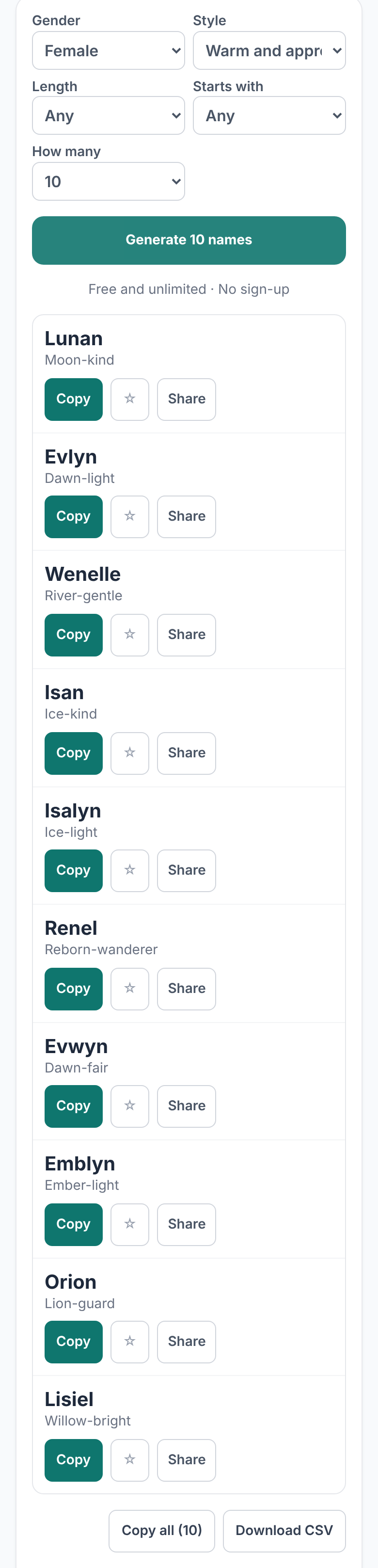
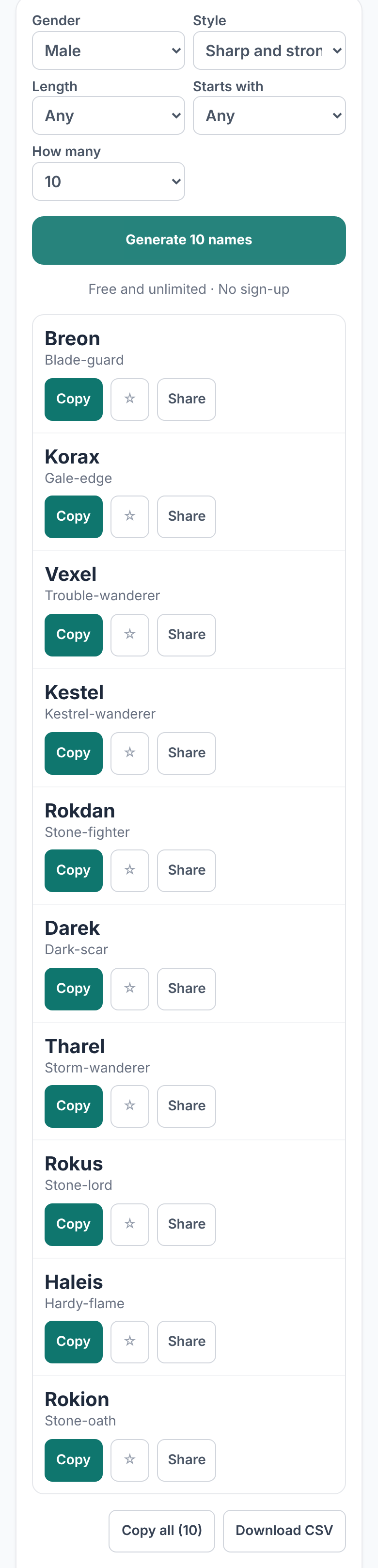
On 2 November 2026 we ran the generator twice on a phone-width screen. Female + warm and approachable gave: Lunan, Evlyn, Wenelle, Isan, Isalyn, Renel, Evwyn, Emblyn, Orion, Lisiel. Male + sharp and strong gave: Breon, Korax, Vexel, Kestel, Rokdan, Darek, Tharel, Rokus, Haleis, Rokion. Our read: Lunan, Wenelle, Emblyn and Lisiel work as hero or love-interest names as they are, and Korax, Darek, Rokdan and Vexel read like rivals or soldiers. Weaker ones: Evlyn and Evwyn, and Isan and Isalyn, are near-twins, Rokdan, Rokus and Rokion all start with Rok, and Orion is an existing name (a constellation), so check it before you use it. Re-click for another ten when a batch has too few keepers.
Sharp names for rivals, villains and soldiers
The sharp style leans on stems like storm, stone, gale and blade with endings such as -ax, -dan, -el and -us. Use it for an antagonist, a mercenary captain or a rival academy student. Short names such as Korax or Darek are easy to type and shout across a scene; longer ones such as Rokion suit a formal title. The first-letter filter keeps your cast from starting with the same letter.
The name elements this generator uses
Warm starts include Ev (dawn), Ser (calm), Lis (willow), Mar (sea), Nya (night), Sol (sun), Ren (reborn), Emb (ember), Wen (river), Isa (ice), Lun (moon) and Ori (lion). Sharp starts include Kest (kestrel), Dre (dragon), Rok (stone), Vex (trouble), Thar (storm), Mor (raven), Kor (gale), Zar (fire), Sab (shadow) and Hale (hardy). Endings include -lyn (light), -ara (grace), -iel (bright), -wyn (fair), -an (kind), -ric (ruler), -dan (fighter), -ek (scar), -ax (edge), -ard (brave) and -ion (oath). The meanings are a guide for your own story, not real-language etymology.
Match the name to era and place
Given names go in and out of fashion. A woman born in the 1940s in the US is more likely to be a Dorothy or Betty than a Madison, so think about when your character was born, not when the story takes place. The same applies to region and family background; a surname can quietly signal heritage.
The names this generator builds are invented, so they suit fantasy, sci-fi and game settings best. For a realistic character in a real time and place, start from historical baby-name lists for the birth year and region, and use the generator for the invented side of your world.
Keep your cast easy to tell apart
Readers track characters by the shape of their names. If your protagonist is Jenna and her best friend is Jenny, or three characters start with M, people will mix them up. Vary first letters, syllable counts and endings across your main cast.
A quick check: write the main characters' names in a list. If any two look similar at a glance, change one. Set the Starts with filter to a letter you have not used yet, and Length to Short or Medium, to fill a specific gap in your cast.
Meaning, sound and symbolism
Some writers like names with hidden meaning, such as a cold character named after winter, but heavy symbolism can feel obvious. Sound often matters more: hard consonants (K, T, D) tend to feel sharp and decisive, while soft sounds (L, M, S) can feel gentle or slippery.
Use the part meanings shown with each result as a starting point, not a rule. If a name feels right but the meaning doesn't matter to your story, keep it. Readers will mostly remember how it sounds.
Testing a Name Before You Commit
Before locking in a name, run three quick checks. Say it aloud next to the surname of another main character; awkward rhymes or repeated sounds show up fast. Type it into a line of dialogue where someone shouts it across a room. Then search it alongside your genre to see whether it already belongs to a famous character.
If two or three names from the list tie, write a one-sentence introduction of the character with each and keep the one you can write most naturally. You can always click Generate again, or tighten the filters, if none of the ten feels right.